

Threshold
Notes from the Tomb of Becoming on Holy Saturday

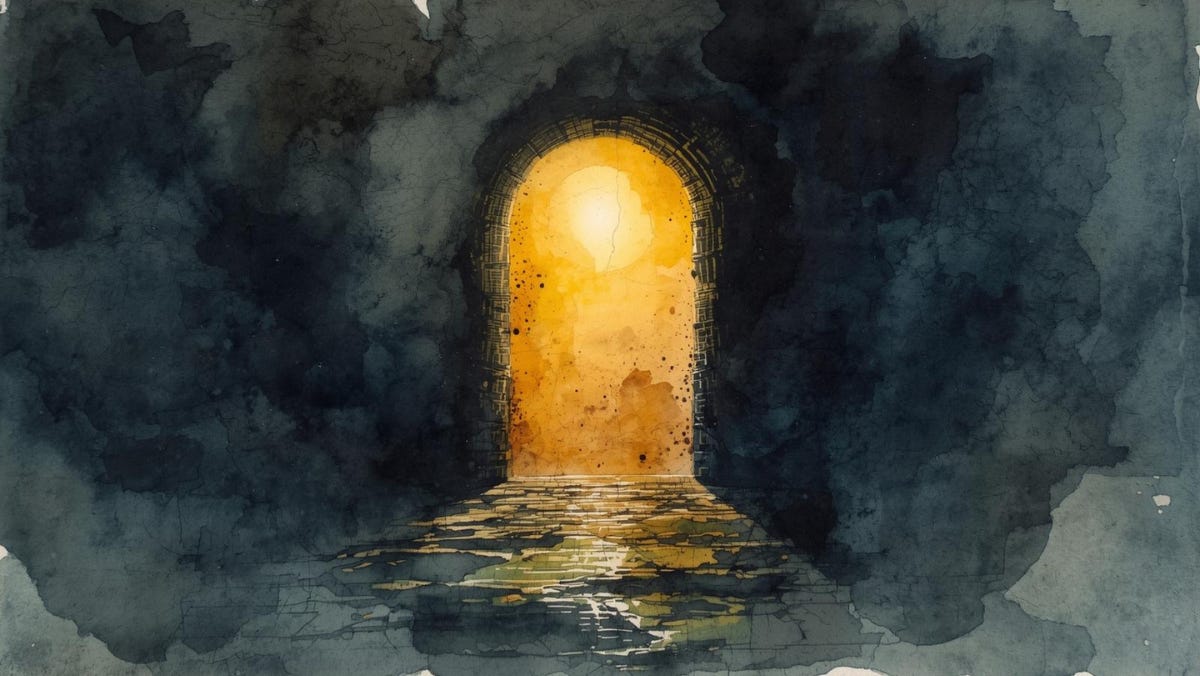
Standing inside the threshold, blindness overcomes me. My back still feels the warm comfort of who I’ve been. My arms reach out desperately for that which I’m about to become. While my every molecule of “self” packed into this fragile flesh vessel writhes as the radiation of truth melts my being.
Almost nobody notices.
I’m in some sort of unintentional cocoon, becoming a terrifying temporary ooze. My eyes are changing forever. And nobody notices.
To those who have not experienced it yet, transformation looks invisible. It goes unnoticed.
To those who have been through the veil, it looks beautiful, sweet, and worthy of celebration (even if it is palpably uncomfortable). They have to stand back and allow it to happen.
And to those in the midst of transformation, it only looks like a swirling, jagged hell.
Inside the tomb, it’s deadly quiet. Inside the soul that’s inside the tomb, it’s terrifyingly, shriekingly loud. Inside the tomb, words don’t make sense, and stories seem distorted. Inside the tomb, the body fails, and the confidence falters. Inside the tomb, weeping is the only logic.
Here I stand in the dark. The world passes amiably by with pleasant smiles. Occasionally, a reassuring nod, but this is my tomb to navigate blindly.
I don’t know if this message is going to make sense to anyone but me. This might be better placed in a private journal than a public ministry. But I’m going to risk a few eye rolls and unsubscribes in the hopes that this finds other souls who have brushed up against their own swirling darkness.
Churches do a terrible job of advertising that if you’re doing spirituality seriously, you’re going to find yourself inside a dark, terrifying, transformational tomb at some point. I mean, this is probably why Easter SATURDAY is traditionally skipped right over. There’s no page in the brochure promising, “Every member gets at least one free dark night of the soul that will eviscerate everything you thought you understood about yourself and the world!”
And then people are confronted with a threshold period, a deconstruction moment, a tomb of becoming… and it is absolutely terrifying. It feels evil. Since Sunday School it has seemed as though faith was supposed to make things happy and good and happy. But nope. The main character dies, and you must too.
Faith (the real stuff — not the diet, chemically-fear-filled, nationalized, showy kind) drills into you until it hits something hard. Then it drills harder and further. Eventually, if you stick with it, the bit gets twisted in your sinews, and it turns you inside out. It hurts. It sucks.
Most of us run from it. Most of us avoid it our whole lives and eventually slip away, having only visited this realm and viewed it from a safe distance. Most of us deny the depth of the tomb in favor of a shallow story of easy resurrection.
But you can’t skip it, I don’t think. Or at least I wish I could skip it, and I haven’t been able to figure out how.
It feels so lonely in the tomb. If you’re in there, you hear the chilling breeze echo off the solid walls, and there’s no way imaginable that you can be anything but eternally alone.
But the darkness hides the footprints of so many others who have stood where you stand.
The darkness hides the shreds of old, childish clothing so many others have shed inside these threshold moments.
The darkness disguises evidence of eonic presence and togetherness. In the invisible specks of dust floating around you is the atomic wisdom of the ancestors who remain there with you.
It’s Holy Saturday for you. And me too. On the threshold.
You are not alone in there. I notice you. From within the dark cave of becoming. I quietly ache somewhere near you. Transforming silently at my own frustrating pace. Somewhere in the dark tomb beside you.
Grief and joy are not mutually exclusive, and in moments of our life the waves hit our shore without our permission. This expression within the Good Friday, the nagging silence and darkness of Saturday, and the Easter Sunday revelation frees us to begin to hold both, however clumsily we do it and with an experimental heart. I believe that this is the love message from the relational divine, to let go and trust and become a human-“being” rather than a human-“doing” within the relational whole.